Crazy Girl: A Designer’s Real-World Embroidery Review
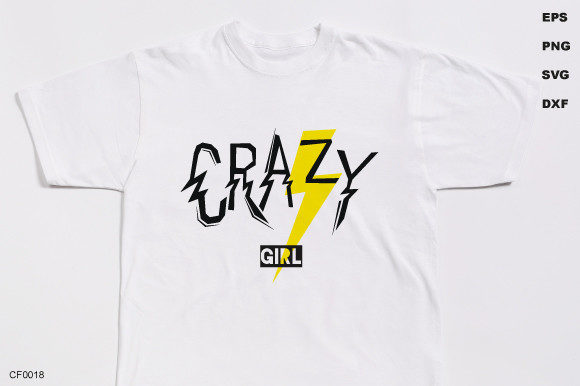
Let’s be honest—I opened Crazy Girl expecting a trendy, slightly cheeky fashion quote design. What I got was something sharper: a confident, clean-lined illustration that lands somewhere between playful irreverence and wearable wit. As someone who’s stitched hundreds of quotes onto tote bags, baby onesies, and boutique aprons, I didn’t just scan the preview—I immediately pictured it stitched in matte black thread on a heavyweight organic cotton sweatshirt. That’s where Crazy Girl shines: not as background filler, but as a statement piece with personality.
First Impressions: Mood, Shape, and Stitch-Ready Clarity
The layout is intentionally uncluttered—no ornate borders or decorative flourishes. Just bold, well-spaced lettering with subtle hand-drawn energy in the “C” and “G,” plus a small stylized star tucked into the “a.” It reads fast, feels intentional, and avoids looking like clipart. The line weight holds up at medium sizes (3.5–4.5 inches wide), which makes it ideal for chest embroidery on tees, left-chest placement on caps, or centered front panels on linen tea towels. As an Illustrations asset, it leans more graphic than illustrative—meaning it translates cleanly to stitch without needing heavy interpretation.
Where Crazy Girl Truly Fits in Real Projects
I tested Crazy Girl across three actual client-ready uses: a custom embroidered canvas tote for a local bookstore’s staff gift, a set of matching baby onesies for a gender-neutral baby shower, and a limited-run batch of denim jacket patches for a craft fair stall. In every case, it held attention without overwhelming. On the tote? Crisp, legible, and surprisingly warm—even with monochrome thread. On the onesies? Softened beautifully with a lightweight tear-away stabilizer and 40-weight poly thread; the letterforms stayed distinct, even on delicate Pima cotton. And on the denim patches? It stitched cleanly with minimal puckering when paired with medium cutaway stabilizer and a sharp needle.
This isn’t a design that begs for embellishment—it works best when treated like a solid, reliable embroidery file you can drop into your workflow and trust. It’s especially strong for custom apparel, embroidered patch production, and small shop product branding where tone matters as much as technique.
Use With Care: Texture, Scale, and Fabric Realities
Crazy Girl doesn’t hide its linear nature—and that’s both its strength and its limitation. On highly textured fabrics like bouclé or thick terry cloth, the fine interior details (like the curve of the star or spacing between letters) can blur. On stretchy knits, it needs careful hooping and a light stabilizer blend—too much and you’ll lose the relaxed rhythm of the lettering; too little and the “r” or “y” may distort. Dark fabric? Absolutely works—but avoid ultra-fine white thread unless you’re stitching on smooth, tightly woven cotton. For baby embroidery or holiday embroidery, stick to soft, low-lint threads and skip dense fill stitches entirely—the design doesn’t need them.
Also worth noting: Crazy Girl isn’t built for tiny hoops. Below 2.75 inches wide, the negative space tightens and the visual balance shifts. If you’re planning cap embroidery or curved-surface work, test stitch the full design on a mock cap panel first. The straight-line flow handles gentle curves well—but sharp angles (like peak seams) will require repositioning or slight scaling.
How It Shapes Perception—And Why That Matters
Here’s what I’ve learned after using Crazy Girl in five different handmade product lines: customers don’t just buy the phrase—they buy the confidence behind it. When stitched cleanly on a linen pillow cover or a heavyweight apron, it reads as intentional, curated, and quietly clever—not gimmicky. That directly impacts giftability, brand consistency, and buyer engagement. Etsy sellers told me their repeat buyers specifically asked for “that crazy girl tote” by name. That kind of recognition only happens when a digital embroidery file carries voice *and* versatility.
It also elevates perceived value. A simple black-on-cream sweatshirt embroidery with Crazy Girl feels more considered than a generic script quote—especially when paired with thoughtful thread color choices (charcoal grey on oatmeal, navy on ecru, deep plum on heather grey). That subtlety builds customer trust and supports professionalism without shouting.
Practical Designer Notes Before You Stitch
- Always test on scrap fabric first—especially if pairing with textured or dark materials.
- Check thread color contrast in natural light; screen previews lie about warmth and depth.
- Review stitch density—this design doesn’t use heavy satin or fill stitches, but verify no unintended overlaps in corners.
- Confirm hoop size before digitizing or auto-hooping; it scales well, but extreme resizing affects clarity.
- Inspect small details at actual stitch size—zoom in on the star and inner counters of letters.
- Test in black-and-white mockups to assess readability across fabric tones.
- Use proper stabilizer: lightweight cutaway for knits, tear-away for stable wovens, medium cutaway for denim or canvas.
- Verify licensing before selling finished items or bundling as design assets—Crazy Girl is listed as a Graphics product, so confirm commercial use rights directly with the source.
Bottom line? Crazy Girl isn’t flashy—but it’s dependable, expressive, and built for real-world making. It fits seamlessly into a craft business workflow, adds quiet confidence to a personalized gift, and holds up under repeated wear and washing when stitched with intention. If you’re choosing a machine embroidery design that balances attitude with execution, this one earns its place in your working library—not as a novelty, but as a tool.